
The Dissociative Identity Disorder Sculpture by Julia O’Sullivan: Exploring Fragmented Identity and Survival

Updated: Aug 31
Dissociative Identity Disorder Sculpture by Julia O'Sullivan

The Dissociative Identity Disorder Sculpture – Identity, Trauma and Survival
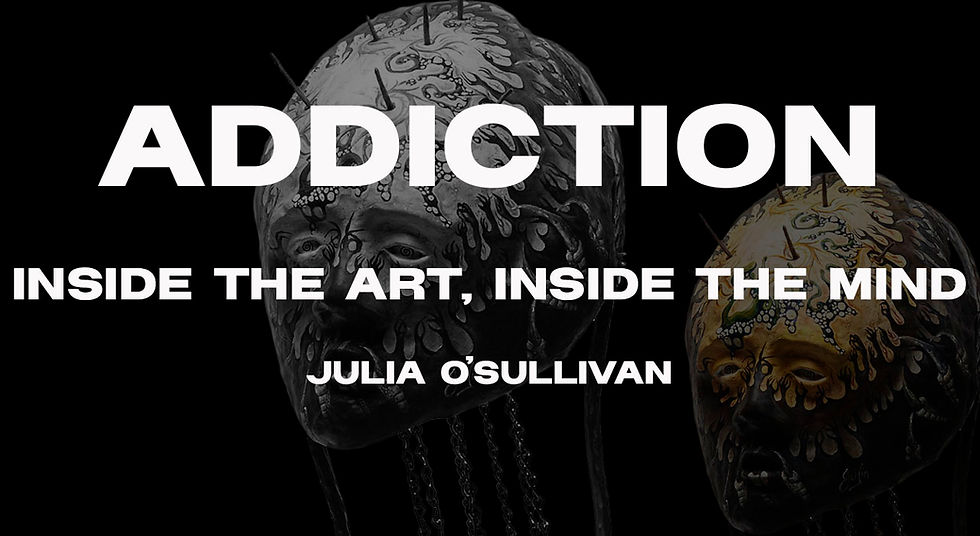
The Dissociative Identity Disorder Head forms part of my sculptural collection, The Disorderly Demise of the Cerebral Cortex.
Of all the subjects within the collection, DID led me towards one of the most complicated questions:
What happens to identity when the mind has had to survive the unbearable?
This sculpture is my artistic response to that question.
Five dramatically different fragments form a single head. Their surfaces reveal different characters, while hidden imagery inside takes the viewer somewhere far more difficult.
I did not want to create a spectacle of "multiple personalities."
I wanted to look beyond that familiar description and towards the reason dissociation may exist at all.
The result is a sculpture about identity, protection and trauma—but above everything else, it is about survival.
Chapter 1 — Who Are We Beneath the Person We Present?
The human mind fascinates me.
We like to think of ourselves as one consistent person, but I've never experienced myself quite that simply.
Different circumstances bring different parts of me to the surface.
I can be strong.
Vulnerable.
Confident.
Defensive.
Funny.
Serious.
Warm.
Difficult.
Sometimes several of those things before lunchtime.
That's ordinary human complexity.
It isn't Dissociative Identity Disorder.
I don't experience DID, and I would never suggest that changing how we behave in different situations is comparable to living with it.
But thinking about the complexity of my own identity gave me a doorway through which I could begin asking questions about something far beyond my personal experience.
How fixed is identity?
How much of ourselves do we reveal?
How much do we protect?
And how much of the person standing in front of us can we ever truly see?
Beyond “Multiple Personalities”
When I began researching Dissociative Identity Disorder, I quickly realised how inadequate the familiar phrase “multiple personalities” was for what I was trying to understand.
It makes the condition sound almost theatrical.
Different characters appearing.
Different personalities taking turns.
Something unusual to observe from the outside.
But the deeper I went into people's accounts and the research surrounding DID, the further away from that idea I travelled.
The subject kept leading me somewhere much more difficult.
Towards trauma.
Towards dissociation.
And towards the extraordinary things a mind may do when attempting to survive experiences it cannot otherwise accommodate.
That changed the sculpture completely.
Why?
Originally, five different faces presented an extraordinary visual opportunity.
Five expressions.
Five characters.
Five ways of transforming my own face.
But simply making five interesting faces wasn't enough.
If I did that, I risked doing exactly what I wanted to avoid — turning DID into spectacle.
So another question became much more important.
Why?
Why might these divisions exist?
What purpose might dissociation have served?
What had happened before the thing we now see?
That question took me away from the appearance of DID and towards something much more important.
Protection
The idea that affected me most during my research was protection.
Rather than looking at dissociation only as something strange or incomprehensible, I began thinking about it as adaptation under extraordinary circumstances.
What if separation had once served a purpose?
What if something that appears confusing from the outside had developed because, at some point, the mind needed a way to endure?
That completely changed how I looked at the five faces I was about to create.
They couldn't simply be characters.
There had to be something beneath them.
Something the viewer wouldn't immediately see.
Something that explained why my interpretation of the outside looked so different from what I would eventually place within.
And suddenly the sculpture was no longer really beginning with five faces at all.
It was beginning with a question about what the mind might do when faced with something it cannot escape.
I began with identity.
I arrived at survival.
Chapter 2 — When Fracture Becomes Protection
When something fractures, we usually assume it has failed.
Broken.
Damaged.
No longer whole.
But while researching DID, I began wondering whether that was always the right way to look at fragmentation.
What if a fracture can also tell us that something fought extraordinarily hard to survive?
That thought changed the direction of the sculpture.
Looking Behind the Division
In the research and personal accounts I encountered, DID was closely connected with experiences of severe and repeated trauma, often beginning in childhood.
That was difficult territory to enter.
But I couldn't create this Head while ignoring it.
Because if I concentrated only on different identities, those identities would become the spectacle.
And I would miss the question that had become far more important to me:
What happened that made separation necessary?
That completely changes where we look.
Instead of staring at the visible difference and asking:
Why is this person like this?
We begin looking behind it.
What might this mind have been trying to survive?
Five Figures — But Not Five People
This was where I had to make an important decision about the five figures I was creating.
I didn't want them interpreted as five literal or universal DID identities.
They aren't.
They are symbols within my interpretation.
I used them to explore different responses, needs and forces that emerged from what I had been researching.
Withdrawal.
Sexuality.
Defence.
Peace.
Vulnerability.
I gave those ideas physical forms because I needed a visual language through which to explore something I couldn't personally experience.
But they aren't intended to say:
This is what the identities of somebody with DID look like.
That would be impossible.
They belong to this artwork.
Which One Do You Notice First?
Some of the figures naturally demand more attention than others.
One may appear stronger.
Another more provocative.
Another defensive.
The viewer's eye can easily be drawn towards whichever seems most visually dramatic.
And I became interested in that too.
Because while everybody is looking at the different faces, there is something much quieter within the sculpture.
Something smaller.
Something much easier to overlook.
A child.
And for me, that child changed everything.
The Smallest Figure
Once I understood where I wanted the child to sit within the sculpture, the five exterior figures began to make more sense.
Because my attention was no longer fixed on what had developed afterwards.
I was thinking about what might have existed before.
Vulnerability.
A young mind.
Something unable to escape what was happening around it.
I didn't want the child to dominate the sculpture.
Quite the opposite.
I wanted the viewer to have to discover that figure.
Because sometimes we become so fascinated by what is visible in the present that we forget to ask what happened in the past.
The different figures might be what initially attract our attention.
But within my interpretation, the child asks the more difficult question.
What happened here?
And once I had placed that question inside the Head, I knew the interior couldn't be comfortable.
If the outside showed the result, the inside had to confront what I believed lay beneath it.
Chapter 3 — Five Fragments, One Story
From the outside, the DID Head is probably one of the most theatrical sculptures in the collection.
Five very different figures occupy the same Head.
They look different.
They behave differently.
They demand attention in different ways.
But I didn't create them as a literal illustration of five identities belonging to somebody with DID.
These characters belong to my sculpture.
They became the visual language through which I explored different responses to vulnerability, trauma and survival.
And each one had a role to play.
The Goth — Withdrawal
The Goth turns inward.
She represents isolation, introspection and retreat.
There is something interesting about withdrawal because we often interpret it negatively.
But sometimes survival isn't about fighting.
Sometimes it is about disappearing somewhere inside yourself until it feels safer to emerge.
I wanted the Goth to carry that quieter form of protection.
She doesn't confront.
She retreats.
The Painted Lady — The Body
The Painted Lady is deliberately confronting.
Her mouth becomes a vagina, merging two things within one disturbing image:
voice and sexuality.
The mouth speaks.
It communicates.
It expresses need.
The vagina introduces the body, sexuality and vulnerability.
Bringing them together creates something intentionally uncomfortable.
I didn't want her to become a judgement on sexuality.
For me, she represents a much more complicated collision between body, identity, desire, vulnerability and being heard.
She is difficult to look at neatly.
She is supposed to be.
The Warrior — Defence
The Warrior doesn't retreat.
She fights.
But I never saw her as aggressive simply for the sake of aggression.
She is defensive.
Protective.
Armoured because something requires armour.
Her strength exists in relationship to vulnerability.
And that distinction matters.
She isn't there because she wants a war.
She is there because something needs defending.
The Hippy — Peace
Then there is the Hippy.
She brings something softer into the sculpture.
Peace.
Freedom.
Beauty.
Connection.
Where the Warrior prepares to defend and the Goth withdraws, the Hippy searches for somewhere gentler to exist.
I needed that.
I didn't want every symbolic response to trauma to become darkness, aggression or fear.
There had to be room for the desire for peace.
For something beautiful.
For the possibility of calm.
And Then There Is the Child
The child is different.
She is smaller.
Quieter.
Easier to overlook amongst the more dramatic figures surrounding her.
And yet for me, she became the emotional centre of the entire sculpture.
Within my visual story, she is the reason everything else begins to make sense.
The Warrior now has something to defend.
The Goth has something to hide.
The Hippy has something for which to seek peace.
And the Painted Lady introduces the far more uncomfortable relationship between body, sexuality, vulnerability and experience.
Suddenly I wasn't looking at five interesting characters.
I was looking at four figures surrounding something vulnerable.
A child.
And that completely changed the way I saw the Head.
I Stitched Them Together
There was still a physical problem to solve.
If these fragments belonged to one sculpture, I needed to join them.
So I stitched them together with copper wire.
And I deliberately left the stitching visible.
I could have tried to disguise the joins.
Smooth them over.
Pretend there had never been a division.
I didn't want to.
The rupture needed to remain visible.
But look at what the wire is actually doing.
It holds.
That became as important to me as the fracture itself.
The stitching doesn't erase what happened.
It doesn't restore some imaginary untouched surface.
Instead, it allows separation and connection to exist at the same time.
The marks remain.
And the structure holds.
Fractured does not necessarily mean destroyed.
Then I Made You Look Inside
The exterior could easily have become the entire spectacle.
Five figures.
Different faces.
Different personalities.
Copper stitching.
Plenty to attract attention.
But if I stopped there, I would have created exactly the artwork I didn't want to make.
Because the question was never simply:
Who are these characters?
It was:
Why are they here?
So the viewer has to look inside.
And the atmosphere changes.
The colourful characters disappear.
The theatrical exterior gives way to imagery connected with abuse, fear and trauma — my artistic response to what I had encountered while researching the experiences associated with DID.
This is where I wanted the sculpture to become uncomfortable for a completely different reason.
Not because the people outside look unusual.
But because of what might lie beneath the need for protection.
Outside Is What We Notice
I think that's the point at which the sculpture turns itself around.
At first, we're looking at difference.
Five striking figures.
Something unusual.
Something visually fascinating.
Then we discover the child.
We notice the stitching.
We look inside.
And suddenly the question isn't:
“Why is this person different?”
It becomes:
“What happened?”
For me, that is the most important movement within the DID Head.
The exterior gives us the fragments.The interior asks us to consider what may lie beneath them.
Outside is what we notice.Inside is what we didn't know.
Chapter 4 — I Made It Whole. Then I Cut It Apart.
By the time I had finished the Head itself, fragmentation existed everywhere.
Five figures.
Visible copper stitching.
An outside and an inside.
Different parts occupying the same structure.
But I didn't want that idea to stop when the sculpture reached its base.
As with every Head in this collection, the plinth needed to continue the story.
And for DID, that meant doing something rather strange.
I made something whole.
Then I deliberately cut it apart.
Many Woods, One Piece
I began with strips of different woods.
Different colours.
Different grains.
Different widths.
I spliced them together until all those separate pieces became one constructed piece of timber.
That was important.
The plinth didn't begin divided.
It began joined.
All those contrasting pieces already belonged to the same structure.
Then I started cutting into it.
Dividing the Whole
I cut out the central section.
Then created another section around it.
And finally the larger outer section.
Three irregular forms, each sitting within the next.
I didn't want perfect circles or neat rings.
The divisions needed to feel organic and slightly unsettled.
But there was something particularly important about the way I made them.
These weren't three unrelated pieces of wood that I later placed beside one another.
They had belonged to the same constructed whole before I separated them.
That changed the meaning of the base for me.
Fragmentation wasn't where the story began.
It was something that happened to something already connected.
The Divisions Remain
When I fitted the sections back together, I didn't disguise the places where I had divided them.
I filled the channels between them with epoxy.
Just as I had left the copper stitching visible on the Head above, I allowed the separation within the plinth to remain visible too.
I didn't want to pretend nothing had happened.
The sections fit together.
They belong together.
But the boundaries remain.
There is a history written into the construction.
And suddenly I realised I had repeated something from the Head without intending simply to reproduce it.
Above, copper wire joins visible fragments.
Below, separate wooden sections return to the structure from which they came.
In both, connection doesn't require the evidence of division to disappear.
Fragmented Does Not Mean Destroyed
This brought me back to something I had been thinking about since I began researching DID.
We use words such as fragmented and immediately imagine something broken beyond repair.
But look at the plinth.
It has been cut.
Separated.
Divided.
And yet it still exists as one complete structure.
Every section remains part of it.
Every strip of timber contributes to it.
Nothing needs to become identical to everything around it in order to belong.
That was important to me.
Not because I am claiming this wooden base explains DID.
It doesn't.
It is my visual interpretation of an idea that stayed with me throughout the making of this sculpture:
division and wholeness do not necessarily cancel one another out.
From the Head Into the Wood
When you follow the finished sculpture downwards, the story travels with you.
The five figures occupy the Head.
Copper wire visibly holds its fragments together.
Inside is the imagery we couldn't see from the exterior.
Then the metal supports carry your eye down towards the plinth.
And there, the idea changes material but doesn't disappear.
Skin becomes wood.
Copper stitching becomes epoxy-filled divisions.
Five visible characters become three nested sections constructed from many different timbers.
But everything still belongs to one artwork.
That is why this plinth could never simply be a stand.
It completes the thought.
I made many pieces into one.
I cut that one structure apart.
Then I brought those separated sections back together without hiding where the divisions had been.
Many pieces.
Visible divisions.
One structure.
Chapter 5 — The Danger of Thinking We Know Someone
When I finished the DID Head, one thought remained with me.
How much do we really know about another person?
We make judgements remarkably quickly.
We meet behaviour before we meet history.
Someone may appear difficult.
Cold.
Defensive.
Intense.
Withdrawn.
Overly sexual.
Angry.
Unusual.
And from those fragments, we begin constructing an entire person.
I have done it.
Most of us probably have.
But creating this sculpture made me think about how little evidence we sometimes require before deciding who somebody is.
We Arrive in the Middle of the Story
When we meet another human being, we don't begin at the beginning.
We arrive somewhere in the middle.
We haven't witnessed everything that shaped them.
We don't know every experience that taught them to protect themselves, withdraw, fight, distrust, perform, hide or survive.
We simply encounter the person standing in front of us.
And then, remarkably quickly, we decide what we think of them.
Perhaps that is what troubles me most.
Not that we don't know everything.
We can't.
It's how easily we can forget that we don't.
Understanding Isn't the Same as Excusing
I don't believe recognising somebody's history means every action must automatically be excused.
It doesn't.
Understanding and accountability can exist together.
But there is a difference between holding somebody responsible for their behaviour and believing that the behaviour we have witnessed tells us everything about who they are.
It doesn't.
A difficult moment is not an entire person.
A coping mechanism is not an entire person.
A diagnosis is certainly not an entire person.
There is always more beyond what we happen to see.
Becoming Less Certain
I don't expect somebody to look at my sculpture and understand DID.
How could they?
I certainly don't claim to understand the lived experience of it simply because I researched and created this Head.
And five symbolic figures could never explain something so extraordinarily complex.
Perhaps the sculpture asks for something much smaller.
To become a little less certain.
Less certain that we know why somebody behaves as they do.
Less certain that the part of them we have encountered is the whole of them.
Less certain that something we perceive as weakness hasn't, at some point, been part of their survival.
That doesn't give us the answers.
But perhaps it changes the questions we ask.
Instead of:
What's wrong with this person?
Perhaps sometimes we might wonder:
What don't I know?
We Never See the Whole
When I look at the finished sculpture now, I see five very different figures.
I see the child beneath them.
I see the copper stitches holding divided sections together.
I see an interior that cannot be understood from looking only at the exterior.
And beneath it all sits a plinth I made whole, deliberately divided, and then brought back together with every boundary still visible.
The entire sculpture is built around fragments.
But no single fragment tells you what the sculpture is.
You have to see the whole.
And perhaps that is what making the DID Head ultimately left me thinking about.
Not simply DID.
People.
The danger of believing that the part of somebody we have been allowed to see — or happened to witness — gives us the right to define everything else.
It doesn't.
We enter people's lives halfway through their stories.
We see moments.
Behaviours.
Defences.
Contradictions.
Fragments.
And from those fragments, we can become terribly certain that we know the whole person.
We meet fragments of people.
We should be careful about believing we have seen the whole.
Perhaps the greatest lesson hidden within this sculpture is that we should never define a person by the fragments we see; every piece, every story and every survival response belongs to a whole human being worthy of understanding, compassion and acceptance.
Discover The Disorderly Demise of the Cerebral Cortex as a complete collection. Meet all seven Heads, explore the ideas that connect them and see how each sculpture approaches a different experience of the human mind.
Step behind the finished sculptures and see how the Heads were actually made. From moulding my own face and experimenting with materials to painting their interiors, constructing their individual plinths and solving the inevitable problems along the way — this is the making of the collection.
The Dissociated Identity Disorder Head is part of The Disorderly Demise of the Cerebral Cortex, a collection of seven contemporary sculptures exploring mental health, identity and the hidden landscapes of the human mind. Each sculpture tells a different story, inviting viewers to look beyond diagnosis and discover the person within. Explore the collection:


Comments