
The Disorderly Demise of the Cerebral Cortex: A Mental Health Sculpture Collection by Julia O’Sullivan

Updated: Aug 14
.
The Disorderly Demise of the Cerebral Cortex by Julia O'Sullivan

The Heads Collection: A Journey Through the Hidden Landscapes of the Human Mind
Mental health is often invisible.
We learn to recognise faces, expressions and the everyday actions of the people around us, but we rarely see the battles, memories, fears and emotions that exist beneath the surface.
Every mind carries a story.
Some stories are shaped by trauma, some by biology, some by experiences we may never fully understand. Yet behind every diagnosis, every struggle and every label, there remains a person — a human being navigating their own unique landscape of thoughts, emotions and experiences.
The Heads Collection was created to explore those hidden worlds.
Through seven sculptural heads, I have explored anxiety, dementia, depression, dissociative identity disorder, bipolar disorder, addiction and schizophrenia. Each piece began with research, reflection and a desire to understand the experiences that shape the lives of others.
But these sculptures are not medical illustrations.
They are emotional landscapes.
They are my interpretation of the invisible places within the mind — the fears, conflicts, memories, strengths and vulnerabilities that make us who we are.
Creating this collection has been a deeply personal journey. I do not simply research a subject and paint it. I immerse myself within it. I search for the emotions behind the words, the human stories behind the conditions and the small details that reveal the complexity of being alive.
I observe the world around me — the subtle movements, expressions and interactions that reveal the hidden layers of human nature. I spend as much time thinking about a piece as I do creating it, allowing the subject to develop within my mind before it takes form through my hands.
There have been moments of sadness, moments of reflection and moments where I have felt the weight of the stories I was exploring. Each sculpture became an emotional release — a way of giving form to experiences that are often difficult to express.
This collection is not about defining mental health conditions.
It is about opening conversations.
It is about looking beyond the surface, challenging assumptions and recognising the person beyond the label.
Because the human mind is not simple.
It is complex.
It is fragile.
It is resilient.
And every mind tells a story worth hearing.
Chapter 1: Where The Heads Began: The Birth of an Idea
Chapter 2: Falling Into the Subject: Research, Emotion and the Creative Process
Chapter 3: The Seven Landscapes of the Mind: Exploring the Hidden Worlds Within
Chapter 4: The Language of Symbolism: Making the Invisible Visible
Chapter 5: The Personal Threads Behind the Collection: Where Art Meets Life
Chapter 6: My Place Within These Stories: An Artist as Observer, Listener and Storyteller
Chapter 7: What This Collection Has Taught Me: An Understanding That Continues to Grow
Chapter 8: Beyond the Diagnosis: The Human Being Within
Chapter 1 – Where The Heads Began: The Birth of an Idea
Every collection begins somewhere.
Sometimes it begins with an image.
Sometimes with a material.
Sometimes with a question that refuses to leave your mind.
For me, The Heads Collection began with a desire to understand what exists beneath the surface of who we are.
As humans, we are incredibly skilled at hiding parts of ourselves. We learn to smile when we are struggling, to continue when we are exhausted and to carry invisible burdens without anyone around us knowing.
The outside world sees the face.
But behind that face exists an entire universe of thoughts, memories, emotions and experiences.
I became fascinated by those hidden landscapes.
What happens inside the mind when someone experiences fear they cannot escape?
What does it feel like when memories begin to disappear?
How does someone navigate a world that feels different from the one everyone else seems to inhabit?
What parts of ourselves do we hide, protect or lose along the way?
These questions became the foundation of this collection.
Created for Mental Health Awareness Week, The Heads Collection was never intended to simply represent conditions or diagnoses. My aim was to explore the human experience behind them.
The struggles people often face silently.
The emotions they may not have words for.
The battles that happen in places nobody else can see.
I wanted to create sculptures that encouraged people to stop and look beyond the obvious.
A person is never just a diagnosis.
A person is never just a symptom.
A person is never defined by the hardest moments of their life.
Each sculpture became a way of exploring that idea.
However, my creative process is not one of simply gathering information and translating it into artwork. I become deeply immersed in every subject I explore.
I fall into it.
I research it.
I think about it constantly.
I search for the emotional truth behind the subject.
I look beyond the facts and try to understand the human experience beneath them.
There have been many times during the creation of this collection where I have cried while painting. Not because the work was impossible, but because I felt the weight of the stories I was exploring.
Art, for me, is not a detached process.
It is an emotional exchange.
I absorb the voices, experiences and emotions around me, and they become part of the work.
I observe the smallest details in people — the way someone holds themselves, the expression that briefly crosses a face, the moments where emotions reveal themselves before words do.
I am fascinated by human nature.
The contradictions.
The struggles.
The resilience.
The hidden stories we all carry.
The Heads Collection became my way of exploring those stories.
Seven heads.
Seven journeys.
Seven different windows into the complexity of the human mind.
Not to provide answers.
Not to claim complete understanding.
But to begin a conversation.
Chapter 2 – Falling Into the Subject: Research, Emotion and the Creative Process
For me, creating art is never just about the final image.
The painting or sculpture is only the visible result of a much deeper process that begins long before I touch the materials.
I do not simply choose a subject, research the facts and begin creating.
I fall into it.
I immerse myself within it.
I live with the subject until it becomes something I feel rather than something I simply know.
When I begin exploring a new idea, I search far beyond the surface. I read, observe, listen and absorb every piece of information I can find. I want to understand not only what something is, but what it feels like to experience it.
The facts are important, but the emotions behind those facts are what guide my work.
I spend as much time thinking about a piece as I do creating it. The artwork develops within my mind long before it appears in front of me. I imagine the emotions, the conflicts, the hidden stories and the symbolism that can transform an idea into something tangible.
For this collection, that process became incredibly personal.
I cried while creating some of these pieces.
Not because I wanted to create sadness, but because I connected with the humanity within the stories I was exploring.
Every sculpture carries the emotions of many voices.
The voices of people who shared their experiences.
The voices of families who witnessed struggles they could not always fix.
The voices of those who have felt misunderstood, isolated or unseen.
And sometimes, the quieter voices within myself.
Art has always been my way of communicating the things that are difficult to say.
The flick of my hand.
The colours I mix.
The textures I create.
These become another language — one that allows me to express thoughts and emotions that words sometimes cannot hold.
I observe the world constantly.
I watch the smallest movements people make.
A change in expression.
A hesitation before speaking.
The way someone carries themselves when they think nobody is looking.
These tiny details reveal the complexity of human nature.
We are all made up of contradictions.
Strength and vulnerability.
Joy and pain.
Confidence and fear.
The person we show the world and the person we keep hidden.
It is within these contrasts that I find my inspiration.
The human mind is not a simple thing to understand. It is a collection of memories, experiences, emotions and survival mechanisms built over a lifetime.
Through these sculptures, I wanted to explore those hidden layers.
Not just the conditions themselves, but the people living alongside them.
One of the greatest lessons this collection has taught me is that understanding is never complete.
Every person I meet, every story I hear and every experience shared has the ability to change my perspective.
I am still learning.
I am still questioning.
I am still discovering.
And I believe that is exactly how it should be.
Because art should not close a conversation.
It should open one.
The purpose of this collection was never to stand above these subjects and claim to know everything.
It was to approach them with curiosity, compassion and a willingness to listen.
To look deeper.
To feel more.
To understand better.
Chapter 3 – The Seven Landscapes of the Mind: Exploring the Hidden Worlds Within
A human mind is never just one thing.
It is shaped by memories, experiences, relationships, fears, dreams and everything we encounter throughout our lives. It carries our joys and our pain, our strengths and our vulnerabilities.
When I began creating The Heads Collection, I did not want to simply represent conditions.
I wanted to explore landscapes.
The unseen places within the mind where emotions, thoughts and experiences collide.
Each sculpture became its own world.
A different journey.
A different conversation.
Together, they form a collection exploring the complexity of what it means to be human.
Anxiety – The Chaos Within
The Anxiety Head explores the overwhelming nature of thoughts that cannot slow down.
Through mathematical equations, spirals, butterflies and chaotic imagery, the sculpture examines the constant search for patterns, control and understanding within an unpredictable world.
It represents the mind caught between order and chaos — the desire to find certainty in something that feels impossible to control.
Dementia – The Person Beyond Memory
The Dementia Head is a reflection on identity, memory and the fear of losing parts of ourselves.
Inspired by my own experience of witnessing dementia within my family, this sculpture explores the person who remains beneath the changes.
Through disappearing colour, fractured memories and a journey into childhood, the piece asks an important question:
When memories fade, where does the person go?
Depression – The Self Behind the Mask
The Depression Head explores the hidden reality behind the face we present to the world.
Through the haunting clown mask, fractured identity and the caged beautiful mind within, the sculpture examines the contrast between appearing well and feeling lost.
It explores the exhaustion of maintaining a version of ourselves that others can accept while our inner world struggles beneath the surface.
Dissociative Identity Disorder – The Many Within One
The DID Head explores identity, survival and the complex ways the mind can adapt.
Created from five stitched sections, the sculpture represents different expressions of self and the protective mechanisms we develop throughout life.
The piece is not intended to define DID or suggest that people with the condition have specific personalities, but rather to explore the idea of the fragmented self and the ways humans navigate their experiences.
At its centre is the reality of trauma — the pain that can shape and fracture the mind.
Bipolar Disorder – The Extremes Within
The Bipolar Head explores the contrast between emotional highs and lows.
Two faces emerge from one form — one looking upward into a world of vibrant colour, energy and chaos, the other facing downward into darkness and isolation.
The sculpture represents two different perspectives within the same person.
Not two people.
Not separate identities.
But one human being experiencing the shifting landscapes of their own mind.
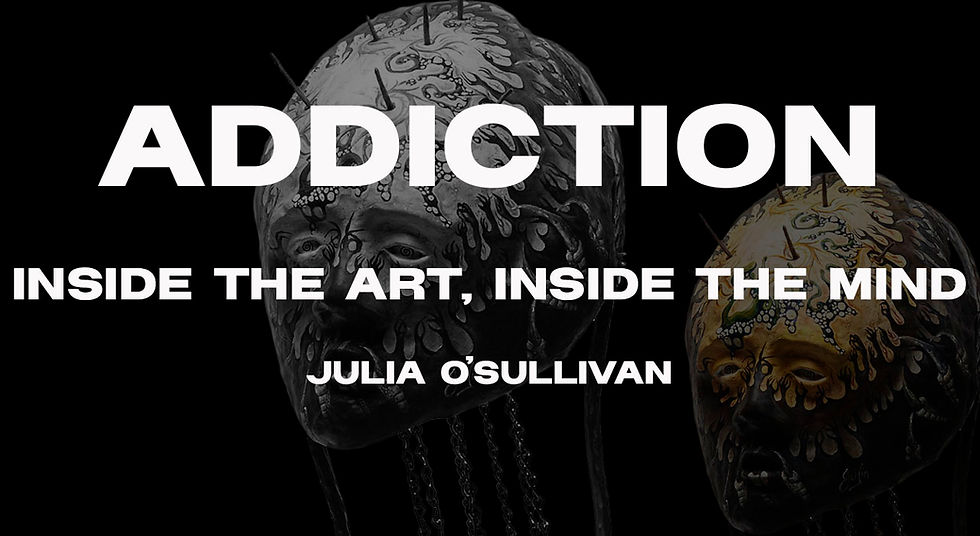
Addiction – The Search for Escape
The Addiction Head explores the cycle of escape, euphoria and entrapment.
Through hypnotic eyes, gripping claws, chains and endless pathways, the sculpture examines the temporary relief that can become a powerful prison.
At its heart is the search for light — the desire to break free from the cycle and rediscover the person beneath the addiction.
Schizophrenia – Perception and Reality
The Schizophrenia Head explores the complexity of perception and the many ways the mind can experience the world.
Created through research and listening to the experiences of others, this sculpture approaches schizophrenia with humility.
Through visual distortions, sensory imagery, shadow figures and internal voices, it explores the emotional reality of experiences that are often misunderstood.
Rather than creating fear, the intention was to create empathy.
Together, these seven sculptures form more than a collection about mental health.
They form a study of humanity.
They explore what happens when the mind is challenged, when identity shifts, when emotions become overwhelming and when people experience the world in ways others may not immediately understand.
Each sculpture represents a different journey.
But beneath them all is the same message:
The person always comes before the label.
The struggle may shape someone's experience, but it never removes their humanity.
Chapter 4 – The Language of Symbolism: Making the Invisible Visible
When exploring something as complex as the human mind, words often feel inadequate.
How do you paint anxiety?
How do you sculpt depression?
How do you give form to memories disappearing, identities shifting or thoughts becoming overwhelming?
The answer, for me, has always been symbolism.
Art allows us to communicate beyond language. It gives shape to emotions that are difficult to explain and allows invisible experiences to become something we can see, touch and reflect upon.
Throughout The Heads Collection, every mark, material and texture has been chosen with purpose.
The heads themselves became the perfect form for this exploration because the mind is where we hold our memories, emotions, imagination and sense of self. Yet the mind is also one of the most mysterious parts of being human — something we experience every moment but can never physically see.
I wanted to reveal what exists beneath the surface.
The outside of each sculpture represents the way experiences interact with the world.
It represents what may be visible to others — the behaviours, emotions and struggles that appear externally.
But inside each head lies another world.
These inner landscapes represent the thoughts, memories and emotions that are often hidden from everyone else.
The person beneath the experience.
The self beneath the struggle.
This contrast became one of the most important elements of the collection.
The outside asks:
"What does the world see?"
The inside asks:
"What is really happening within?"
Throughout the sculptures, I use recurring symbols to represent different emotional states.
Chains represent feelings of being trapped.
Cages represent restrictions placed upon the mind.
Masks represent the versions of ourselves we present to the world.
Cracks represent vulnerability, damage and the places where something deeper can emerge.
Darkness often represents emotional pain, while light represents hope, understanding and the possibility of change.
Colour is also a powerful language within my work.
Bright colours can represent energy, chaos, excitement or overwhelming emotion.
Muted colours can represent loss, isolation or the fading of something once vibrant.
Sometimes colour is not simply decoration.
Sometimes it is the emotion itself.
The materials also carry meaning.
Metal, wire, wood and sculptural elements become part of the story rather than just the structure holding the piece together.
Every choice becomes another layer of communication.
The longer I spend with a subject, the more the symbolism develops. A single image may begin as an idea but transform as my understanding grows.
That is why my sculptures are not created quickly.
They need time.
Time to research.
Time to think.
Time to feel.
Time to discover what the piece is trying to say.
Perhaps the most important thing I have learnt through creating this collection is that symbolism does not have one fixed meaning.
The artist may create with an intention, but the viewer also brings their own experiences, emotions and interpretations.
A piece of art becomes a meeting point between two minds.
The creator and the observer.
The story being told and the story being felt.
And perhaps that is why art has such power.
It allows us to explore experiences we may never have lived ourselves, while still finding something human within them.
Chapter 5 – The Personal Threads Behind the Collection: Where Art Meets Life
Although The Heads Collection explores mental health conditions, at its heart it is a collection about people.
Every sculpture carries a human story.
Some stories came from research.
Some came from listening to others.
Some came from the experiences of people I love.
And some came from the quieter parts of myself.
Art is often described as a form of expression, but for me it has always been a form of connection. It allows me to explore emotions, experiences and questions that sometimes feel too complex to explain through ordinary conversation.
These sculptures are not separate from my life.
They are woven into it.
The Dementia Head carries a deeply personal connection through my father. Watching someone you love change because of dementia teaches you that memory is not the only thing that defines a person.
Behind the confusion, behind the changes, behind the illness, there is still someone who has lived, loved and left an imprint on the people around them.
That sculpture became a reflection on identity, memory and the person who remains when parts of the mind begin to disappear.
The Depression Head was created from another deeply personal place.
My husband has lived with depression for many years, and through our life together I have witnessed the difference between the person someone appears to be and the internal struggles they carry.
Depression taught me that suffering is not always visible.
Someone can smile, work, love and support others while carrying a heaviness that few people ever see.
Creating that sculpture became a way of exploring not only depression itself, but the love, patience and understanding that exists alongside it.
The Addiction Head also carries personal reflection.
Through my own experiences and through witnessing addiction's impact on those close to me, I came to understand the complicated relationship between escape, relief and self-destruction.
Addiction is often viewed only through judgement, but beneath it is a human being searching for something — comfort, release, silence or a moment away from pain.
Understanding does not remove responsibility, but it does allow compassion.
The remaining sculptures were approached differently.
For anxiety, bipolar disorder, dissociative identity disorder and schizophrenia, my understanding came through research, listening and trying to approach each subject with respect.
I knew I could never fully experience what another person experiences.
But I could listen.
I could learn.
I could create a space where those experiences were treated with dignity.
This collection has reminded me that every person carries invisible battles.
Some are visible.
Some remain hidden.
Some are understood.
Some are not.
But all belong to someone.
That is why I believe art has the ability to create connection. It allows us to step briefly into another person's world and consider experiences beyond our own.
The purpose of these sculptures was never to create distance between "us" and "them".
Because there is no "them".
There are only people.
People trying to navigate life with the minds, memories and experiences they have been given.
And perhaps that is the thread connecting every sculpture in this collection:
Behind every condition is a person.
Behind every struggle is a story.
And behind every story is a human being worthy of understanding.
Chapter 6 – My Place Within These Stories: An Artist as Observer, Listener and Storyteller
Creating this collection has taught me that every work of art is shaped by the position from which it is viewed.
As artists, we are never completely separate from the subjects we explore, yet we are never entirely inside another person's experience either.
That distinction became one of the most important lessons throughout the creation of The Heads Collection.
Some of these sculptures were born from deeply personal connections.
Some came from the experiences of people I love.
Some came from emotions I recognised within myself.
Those pieces allowed me to create from a place of personal understanding, empathy and reflection.
But others required a different approach.
They required me to listen.
They required me to learn.
They required me to accept that I was standing outside an experience I could never truly claim as my own.
The Schizophrenia Head made me particularly aware of this.
Here, I stood as an observer.
I could not see the world through the eyes of someone living with schizophrenia, and I would never pretend that I could.
My understanding came through listening to people's experiences, reading first-hand accounts and trying, as honestly as possible, to understand a reality different from my own.
In truth, apart from the Addiction Head, I remain an observer to many of the subjects explored within this collection.
Even where I share emotional connections or recognise parts of myself within the work, there are experiences that belong only to those who live them every day.
And I believe that recognising this is important.
Because art carries responsibility.
When we explore another person's experience, especially something as personal as mental health, we must approach it with humility.
The purpose is not to take ownership of someone else's story.
It is not to speak over those who live it.
It is to create space for understanding.
My role was never to say:
"This is what this condition is."
Instead, my role was to ask:
"How can I help people look closer?"
"How can I encourage conversation?"
"How can I help someone see the person beyond the label?"
The more I created this collection, the more I realised that listening is one of the greatest tools an artist can have.
Research gives us knowledge.
But people give us understanding.
Every account I read, every story I encountered and every conversation I had added another layer to my perspective.
They reminded me that the human mind is far more complex than any diagnosis could ever explain.
Whether these sculptures were created from lived experience, personal connection or careful research, my hope has remained the same:
That every piece treats its subject with honesty, dignity and respect.
I know that my understanding will continue to grow.
It should.
Life continues to educate us.
Every person we meet has something they can teach us, and every story has the ability to challenge what we thought we understood.
Perhaps that is one of the greatest gifts of art.
It allows us to step briefly into another person's world.
Not to claim we know exactly what it feels like.
But to leave with a greater willingness to understand.
If these sculptures encourage even one conversation, challenge one misconception or help one person feel seen, then they have achieved exactly what they were created to do.
Because sometimes the most important thing we can offer another person is not an answer.
It is the willingness to listen.
Chapter 7 – What This Collection Has Taught Me: An Understanding That Continues to Grow
When I began creating The Heads Collection, I thought I was exploring mental health.
What I discovered was that I was exploring humanity.
Each sculpture began with a subject, but every subject led me somewhere deeper — into questions about identity, emotion, survival, trauma, resilience and the experiences that shape who we become.
This collection has taught me that understanding is not something we simply achieve.
It is something we continue to build.
Every story I listened to changed my perspective.
Every person I encountered reminded me that there is always more to learn.
The human mind is far too complex to be placed into simple categories, and every person’s experience is shaped by their own history, relationships, struggles and moments of survival.
Creating these sculptures has reminded me that we should never stop being curious about one another.
It is easy to make assumptions about what we do not understand.
It is much harder, but far more rewarding, to ask questions, listen and allow someone else's experience to expand our own view of the world.
This collection has also taught me something about myself.
I have learnt that my art is not created from a distance.
I cannot simply observe a subject and remain untouched by it.
I absorb.
I question.
I feel.
I search for the emotional thread that connects us all.
Sometimes that process has been difficult. Some of these stories carried immense pain, and there were moments where I had to step away and allow myself time to process what I had learned.
But those moments were also where the most important discoveries happened.
Because behind every struggle I explored, I found something else.
Strength.
Courage.
Adaptation.
The incredible human ability to continue moving forward even when life becomes impossibly difficult.
One of the greatest lessons this collection has given me is the understanding that nobody is ever just one thing.
A person is not their diagnosis.
A person is not their trauma.
A person is not the hardest moment they have experienced.
We are all made from countless pieces.
Our memories.
Our relationships.
Our fears.
Our hopes.
Our experiences.
The things that have hurt us and the things that have helped us heal.
This collection has also reminded me that my own understanding will never be complete.
And I am grateful for that.
To believe we know everything leaves no room for growth.
I want to continue learning.
I want to continue listening.
I want to continue allowing the people and experiences around me to challenge my thoughts and expand my understanding.
Every piece of art I create becomes a moment in time — a reflection of what I understand at that point in my journey.
But life continues.
People continue to teach us.
Our perspectives continue to evolve.
Perhaps that is why art matters.
It does not have to provide every answer.
Sometimes its greatest purpose is to make us stop.
To make us question.
To make us look again.
The Heads Collection began as an exploration of the mind.
It became an exploration of compassion.
And ultimately, it became a reminder that although our experiences may be different, our humanity connects us all.
Chapter 8 – Beyond the Diagnosis: The Human Being Within
When I began creating The Heads Collection, I started with seven subjects.
Seven conditions.
Seven different journeys into the human mind.
But as the collection grew, I realised these sculptures were never truly about diagnoses.
They were about people.
They were about the person behind the anxiety.
The person behind the dementia.
The person behind the depression.
The person behind the trauma.
The person behind the addiction.
The person behind the altered perceptions and experiences of the mind.
A diagnosis may describe one part of someone's experience, but it can never describe the entirety of who they are.
No person can be reduced to a word.
No life can be contained within a label.
Every individual carries a universe within them — memories, relationships, dreams, fears, hopes and stories that nobody else will ever fully know.
That is what I wanted these sculptures to explore.
The invisible worlds that exist within all of us.
The parts we share.
The parts we hide.
The parts we struggle to understand.
Throughout creating this collection, I have been reminded again and again that compassion begins with curiosity.
Before we judge, we should ask.
Before we assume, we should listen.
Before we separate ourselves from another person's experience, we should remember that we are all navigating the complexities of being human.
Mental health affects everyone in some way.
Through ourselves.
Through our families.
Through our friendships.
Through the people we pass every day without knowing the battles they may be carrying.
Perhaps the greatest misconception is that these experiences belong only to "other people".
They do not.
They are part of the human story.
Creating these sculptures has changed the way I see the world.
I have learnt that the mind is fragile, but it is also extraordinary.
I have seen pain transformed into strength.
I have seen suffering met with courage.
I have seen people continue, adapt and survive even when their path has been incredibly difficult.
These sculptures are my attempt to honour those stories.
Not to define them.
Not to speak for them.
But to create a space where they can be acknowledged.
If someone stands before these pieces and sees only illness, then perhaps they have only seen the surface.
Look deeper.
Look beyond the cracks, the chains, the darkness and the chaos.
Because within every sculpture there is something else.
A person.
A story.
A life.
And perhaps that is the most important thing this collection can remind us:
The mind may shape our experiences.
Our struggles may influence our journey.
But they never take away our humanity.
Every mind tells a story.
Every story deserves to be heard.
And every person deserves to be seen.
Beyond the Sculpture — Enter the Journals
These sculptures were never intended simply to be looked at.
Each began with a question:
How do you make something largely invisible, visible?
Mental health cannot always be understood from what we see on the outside. A face can smile while something very different is happening within. That contrast became fundamental to this collection and to the way I constructed each head.
But the sculpture alone cannot tell you everything.
So alongside each work I have written a journal that takes you further into its story—why I chose particular imagery, what the symbolism means, where my understanding came from and, importantly, where the limits of that understanding lie.
Some of these works grew from experiences very close to me. Others required me to stand outside an experience I have never lived, listening, researching and trying to interpret it through the eyes of an artist.
I don't claim to know what another person's mind feels like from the inside.
These are my interpretations.
My observations.
My attempt to turn something difficult to see into something we might begin to talk about.
Before entering each journal, I invite you to look at the sculpture first.
What do you notice?
What does the outside tell you?
What might be happening inside?
Why have I exposed some things and concealed others?
Does anything resonate with an experience you recognise—in yourself or perhaps in somebody you have known?
Then read the story behind it.
You may understand my choices differently afterwards. You may disagree with some of them. You may see something in the sculpture that I never consciously put there.
That's part of the conversation.
These journals aren't medical explanations of mental health conditions. They are the stories behind artworks created in an attempt to understand something of the human experience.
Choose a sculpture below and enter its journal.
The seven journal links
I'd then make each sculpture an invitation rather than a description:
ADDICTION — When Something Takes HoldWhen does desire become dependence, and what does it take to find a way out?
ANXIETY — When the Mind Won't Be QuietWhat happens when thought begins spiralling faster than we can control it?
BIPOLAR — Between Two ExtremesHow can the same mind experience such profoundly different worlds?
DEMENTIA — When the Person Begins to DisappearWhat remains when memories, recognition and pieces of a familiar personality begin to slip away?
DEPRESSION — Behind the Face We Show the WorldHow much can be hidden behind an ordinary smile?
DISSOCIATIVE IDENTITY DISORDER — Who Is Protecting Whom?What might the mind create when survival demands somewhere else to go?
SCHIZOPHRENIA — A Reality I Cannot SeeHow do I, as an outsider, attempt to represent a reality I have never lived?


Comments