
The Seven Deadly Sins collection: A Dark and Powerful Art series
- Julia O'Sullivan of Jupigio-Artwork

- 3 days ago
- 17 min read
Twenty Years Exploring the Seven Deadly Sins
Where to start? For the past twenty years I have been exploring the subject of the Seven Deadly Sins. I have always been a deep thinker, fascinated by what drives people to behave the way they do. Why do we make the choices we make? What lies beneath our actions? Over time, these questions naturally found their way into my art.
It began with The House of Sin and The House of Virtue—two companion paintings that explored opposing aspects of human nature. The House of Sin featured seven windows, each revealing one of the deadly sins. In contrast, The House of Virtue offered different views of the corresponding virtues. Together they formed a dialogue. Sin was portrayed as rich, seductive and lavish in its tapestry, while virtue appeared colder, quieter and, perhaps, more isolating. One painting could not exist without the other.
The next body of work was The Carnival of Sin. Here, each sin became a fairground attraction. Lust appeared as the fortune teller, Greed as the ringmaster, and each remaining sin took on its own carnival role. Although presented as a single artwork, every section was conceived as an individual painting, fitting together like pieces of a jigsaw to create one complete spectacle.
From there I moved to Dante's Inferno. While each of the Seven Deadly Sins is represented within Dante's vision of Hell, this work was less concerned with my own interpretations of sin and more with bringing Dante's extraordinary narrative to life through sculpture.
Sinful Fairies became a lighter, more playful interpretation of the same theme. A series of seven watercolour paintings, each fairy embodied one of the deadly sins while retaining a sense of fantasy and whimsy.
And now we arrive at my current collection. I believe these are the most accomplished works I have created on the subject.
Pride

We begin with Pride.
How do I perceive Pride? Simply by looking at the world around me.
The age of technology has fuelled perhaps the greatest explosion of ego humanity has ever experienced. We live in the era of influencers, motivational slogans, carefully curated lifestyles, endless word salads and empty platitudes. Social media encourages us to admire them, aspire to become them, and measure our worth against carefully edited versions of reality. Instagram, TikTok and countless other platforms have turned self-promotion into an art form.
Then there are politicians. Power has always attracted those who crave it, and perhaps it always will. Like moths to a flame, people pursue positions of influence, prestige and status. To become President, Prime Minister, or to receive titles and honours should be a privilege of service, yet so often these positions become stages upon which unchecked egos perform. Their pride unfolds in real time, broadcast for the entire world to witness.
But it is not only politicians. Activists, musicians, artists, sportspeople—we all walk the fine line between confidence and vanity. Success can so easily become self-importance.
And what about the rest of us?
Ask yourself honestly: are you buying that new car because you truly want it, or because you want to be seen driving it? Are you choosing something because it enriches your life, or because it enhances the image you project?
However we choose to look at it, every one of us carries these sins within us, each to a different degree. They are part of being human. The challenge is not to pretend they don't exist, but to recognise them before they begin to consume us or harm others through our actions.
There is nothing wrong with owning a beautiful car, a successful business or a comfortable home. The question is not what we desire, but why we desire it. Our motives reveal where Pride quietly begins to take hold.
Like all the deadly sins, Pride is deeply destructive. But is it simply an emotion? Or is it a force that drives us? Have we been conditioned to believe we need it? Modern marketing certainly thinks so. Convince people they need to appear better than their neighbour and you have one of the most powerful sales tools ever invented.
I hate to break it to the human race, but I think we've all been duped.
Personally, Pride is not the sin I struggle with most. Of course I have moments of pride—as we all do—but over the years I have learned to question my own motives. Asking yourself why you are doing something is one of the most valuable habits you can develop. If your intentions ultimately harm someone else, then no amount of self-justification can make them right.
People have an extraordinary ability to convince themselves that almost anything is acceptable if it allows them to sleep peacefully at night.
Perhaps we should all begin each morning by giving ourselves an honest talking to. Ask who we want to become today. Keep the ego in check. Aim to be a little more humble, a little more compassionate, and a little more aware of the reasons behind our actions.
Because Pride rarely arrives announcing itself.
It whispers.
Envy

What is my take on Envy?
In many ways, Envy complements Pride. The two are closely intertwined. Pride seeks admiration, while Envy looks upon what another possesses and longs for it. One feeds the other.
Do I experience envy? Occasionally, of course—I am only human—but it is not one of the sins I struggle with in any great measure.
So what does Envy look like today?
Like Pride, it has become a powerful force driving the modern economy. Clever marketers understand human nature all too well. They know that if they can make us feel that someone else has something we lack, they can persuade us that we need it too.
Politicians envy power.
The wealthy may envy those with greater influence.
The average person may envy wealth, success, or the appearance of the perfect life.
Those struggling financially may envy people who simply enjoy life's basic comforts.
The old envy youth.
The young envy experience.
The list goes on and on.
At some point in our lives, every one of us will envy something another person has. The challenge is not to eliminate envy entirely—that would be impossible—but to stop it from taking control.
There is nothing wrong with aspiring to achieve what someone else has achieved. In fact, ambition can be healthy. The danger comes when envy turns bitter; when we begin wishing others would fail simply because we cannot bear to see them succeed.
Whenever you catch yourself wanting another person's life, ask yourself a simple question: Would having what they have genuinely improve my life?
If the honest answer is no, then there is nothing to envy.
If the answer is yes, then perhaps what you are feeling is not envy at all, but inspiration. Let it motivate you to work towards your own goals rather than tearing someone else down.
Destroying another person's success will never satisfy the emptiness that envy creates. Even if you gain what they lose, it will always feel hollow because it was never truly yours.
Most successful people have worked tirelessly for what they have. Their achievements should be admired rather than resented. Learn from their example. Study what they did. Put in the work yourself.
The satisfaction of earning something through your own effort is infinitely greater than simply possessing it. That, to me, is the true meaning of success. Whether it brings wealth or not, it fills something far more important—your soul.
Envy, when kept in check, can be a useful guide. It can reveal what we value and encourage us to grow. Left unchecked, however, it becomes destructive. It seeks to diminish others rather than improve ourselves. It is one of the reasons so many people remain dissatisfied, even when they have money, status, or every outward sign of success.
When you feel envy rising within you, pause for a moment.
Ask yourself why.
Then replace envy with admiration.
Tell yourself, "It's alright to admire what someone else has. If I truly want it, I can work towards it too."
That simple shift in perspective transforms envy from a destructive force into a source of purpose. Instead of poisoning the soul, it becomes the spark that encourages us to become better versions of ourselves.
Sloth

Let me tell you about my interpretation of Sloth.
Traditionally, Sloth is described as laziness. But I believe it is far more than simply not wanting to get off the sofa. To me, Sloth is a state of mind.
It is perpetual procrastination. It is allowing life to drift past without truly engaging with it. It is the slow, quiet wasting of the greatest gift we have ever been given—time.
Sloth is not concerned that it never fulfils its potential. It is content to watch others carry the burden. It seeks the easiest path, the smallest effort, and often the greatest reward for doing the least. It has no drive, no passion, no curiosity, no hunger to experience life.
It is a black hole of wasted time.
The danger of Sloth is that it is comforting. It whispers that tomorrow will do. That there is always another chance. Another week. Another year. Before we know it, decades have slipped through our fingers.
Like gravity, Sloth pulls us in slowly. It encourages routine over adventure, excuses over action, comfort over growth. It is easy to become trapped in its orbit because doing nothing often feels easier than risking failure by doing something.
To live below your potential is one thing; we all have limitations and difficult seasons. But to consciously choose not to make the effort—to repeatedly avoid growth when we have the opportunity—is, to me, the true nature of Sloth.
Over the years I have met many people who seem content with simply getting by. They work only when they have to. They look for ways to avoid responsibility rather than embrace it. They settle into habits that require as little effort as possible. This is not a judgement of their worth as people; it is simply an observation of a mindset.
The truth is that every one of us experiences Sloth to some degree. None of us is free from the Seven Deadly Sins. We all have moments when we procrastinate, avoid difficult tasks, or choose comfort over progress.
The question is whether we allow those moments to become our way of life.
Break free from Sloth.
Get up.
Change your habits.
Learn something new.
Walk more.
Smile more.
Breathe deeply and engage with the world around you.
Life is an extraordinary gift, and time is the one thing we can never reclaim. We are each given only one ticket for this remarkable journey.
Don't spend it sitting in the waiting room.
Live it.
Greed

What am I going to say about Greed?
Perhaps this is the easiest sin to recognise because the modern world seems to celebrate it.
We live in a society where success is so often measured by accumulation. The bigger the house, the faster the car, the larger the bank account, the more successful we are told we must be. Yet I cannot help but wonder—at what point does enough become enough?
To me, Greed begins when we stop valuing people and start valuing possessions. When we choose assets over relationships. When our self-worth is measured by what we own rather than who we are.
Greed builds a fragile kingdom. It may appear magnificent from the outside, but it rests upon shallow foundations. Those consumed by it often admire one another's wealth, reinforcing the belief that more is always better. Their wallets grow heavier while their souls become lighter.
Greed, in its ugliest form, is a truly ugly creature.
When I see someone striving to become a billionaire, or even a trillionaire, I find myself asking one simple question:
Why?
Why own four houses when you can only live in one at a time?
Why collect fifty cars when you can only drive one?
Why own a yacht the size of a village?
What purpose does it truly serve?
These are not questions about money itself. There is nothing wrong with working hard, building a successful business, or enjoying the rewards of your labour. Achievement should be celebrated.
The question is this: when does wealth stop serving your life and begin to consume it?
Greed is not about making money. It is about never believing you have enough.
It always wants one more house.
One more business.
One more million.
One more victory.
It is a hunger that can never be satisfied because it feeds upon itself.
The tragedy is that while Greed gathers more than it could ever use, someone else is often left with less. Greed takes more than its place at the table. It forgets that prosperity can be shared, and that generosity enriches everyone.
There comes a point where endless accumulation carries a cost—not to your bank balance, but to your soul.
At the end of life, your possessions will remain behind. The expensive watch, the luxury cars, the impressive portfolio and the grand houses will all belong to someone else. None of them can accompany you.
What will remain are the lives you touched, the kindness you showed, the generosity you gave, and the legacy you leave in the hearts of others.
That is true wealth.
So try not to fall into Greed's trap.
Value your work and accept fair reward for it. Build a comfortable life if you can. There is nothing wrong with success.
But never believe your wealth makes you more valuable than another human being.
Nobody stands above anyone else.
We are all equally human.
We each laugh, we each cry, we each love, and one day we all leave this world in exactly the same way.
I have never believed anyone is beneath me, nor above me. I simply try to meet people where they stand. If you offer kindness, I will return kindness. If you make me laugh, I will laugh with you. If you show me respect, you will have mine in return.
No matter where life takes us, we all begin and end the same.
Never forget that.
Gluttony

Well, well, well... Gluttony.
My interpretation of Gluttony goes far beyond simply eating or drinking too much. To me, it is the sin of excess.
Ironically, this is one of the sins I recognise most readily in myself.
Gluttony is alive and thriving in the modern world. It hides in plain sight amongst the bright lights of consumerism. It lines the supermarket shelves with endless temptation and whispers that we need just a little more.
More food.
More clothes.
More gadgets.
More possessions.
More.
We buy food we never eat, only to throw it away days later. We buy gifts because we have been conditioned to believe that bigger means better. We fill our homes with things we neither need nor use, convinced that owning more somehow makes life richer.
We have become servants to the marketplace.
Somewhere along the way we were persuaded that consumption equals happiness.
But does it?
Gluttony isn't simply about overeating. It is about over-consuming everything.
Food.
Entertainment.
Technology.
Clothing.
Space.
Resources.
Even time.
The greatest casualty of this endless appetite may well be the planet itself.
Why are we no longer content to eat fruit and vegetables when they are naturally in season? Why must every ingredient be available every day of the year? Why is one glass of wine not enough? Why must every celebration become a feast?
Our lives, particularly in the wealthier parts of the world, have become bloated with abundance.
We have been taught to believe we are entitled to it.
To satisfy our appetite we over-farm the land, empty the oceans, exhaust natural resources and often ignore the human cost hidden behind cheap prices. We happily enjoy fruit picked by children on the other side of the world, provided it arrives fresh and at the price we expect to pay.
Gluttony rarely asks who pays the real cost.
It simply wants more.
Look inside your fridge.
Open your cupboards.
Walk around your home.
How much of what you own do you truly need?
Gluttony surrounds us so completely that we barely notice it anymore. It has become normal.
History reminds us that life was once very different. During times of rationing, people had enough to survive, but many longed for the extravagant banquets enjoyed by the wealthy. Scarcity made excess appear desirable.
Today, we have largely swung to the opposite extreme.
We eat beyond hunger.
We buy beyond necessity.
We consume beyond reason.
Our desires have become overweight.
And now, in a strange twist of irony, we invent treatments to counter the consequences of our excess. We want to indulge without paying the price. We want to consume endlessly while avoiding the reflection in the mirror that reminds us what our appetites have become.
Gluttony is a monster with an insatiable appetite.
The more we feed it, the hungrier it becomes.
Perhaps the antidote is not deprivation but gratitude.
To appreciate enough.
To savour rather than consume.
To value quality over quantity.
To remember that abundance is not measured by how much we possess, but by how much we truly appreciate.
Because, in the end, enough really can be enough.
Lust

I find Lust to be one of the most destructive of the Seven Deadly Sins.
It is the sin that tears apart worlds, dreams and hope.
Most people think of Lust only in terms of physical desire, but I believe it is much broader than that. It is the overwhelming craving for something we are willing to pursue without conscience or restraint. It can be the lust for power, the lust for fame, the lust for wealth, the lust for recognition, or the lust for another person who does not return those feelings.
Lust is desire that refuses to accept limits.
It reaches out and takes what it wants.
It thirsts for the thrill of possession, caring little for the destruction left behind. It wants, it takes, and it moves on, leaving broken relationships, shattered trust and damaged lives in its wake.
To me, Lust is primal.
It is a contorted figure, blinded by its own hunger. It has little empathy, little reason and little honour. Once consumed by its craving, it struggles to recognise the humanity of those standing in its way.
Lust becomes a machine with no regret.
I see Lust through many windows of the modern world.
I see families torn apart by betrayal.
I see governments pursuing power with little regard for the people they serve.
I see corporations chasing profit at any cost.
I see individuals sacrificing integrity in exchange for admiration, status or influence.
Everywhere I look, I see desire unchecked by wisdom.
Like every deadly sin, Lust exists within all of us to some degree. Desire itself is not the enemy. Without desire we would never create, never love, never improve ourselves or pursue our dreams.
The danger begins when desire becomes obsession.
When what we want becomes more important than the people we hurt to obtain it.
That is where Lust reveals its true face.
Lust rarely acts alone.
It invites Pride to justify its actions.
Greed encourages it to take more.
Envy whispers that we deserve what belongs to someone else.
Wrath erupts when it is denied.
The Seven Deadly Sins are never far apart.
Lust is intoxicating. It draws people into its playground, convincing them that just one more step won't matter. It feeds on excitement, secrecy and validation, making us believe that consequences belong to someone else.
But they always return.
Because Lust cannot sustain itself.
It burns brightly, but briefly.
It is born in the shadows, flourishes in secrecy, and eventually consumes the very thing it desired in the first place.
The antidote to Lust is not the absence of desire.
It is self-control.
It is respect.
It is recognising that every decision we make affects another human being.
True strength is not found in taking whatever we desire.
It is found in knowing when to walk away.
Wrath
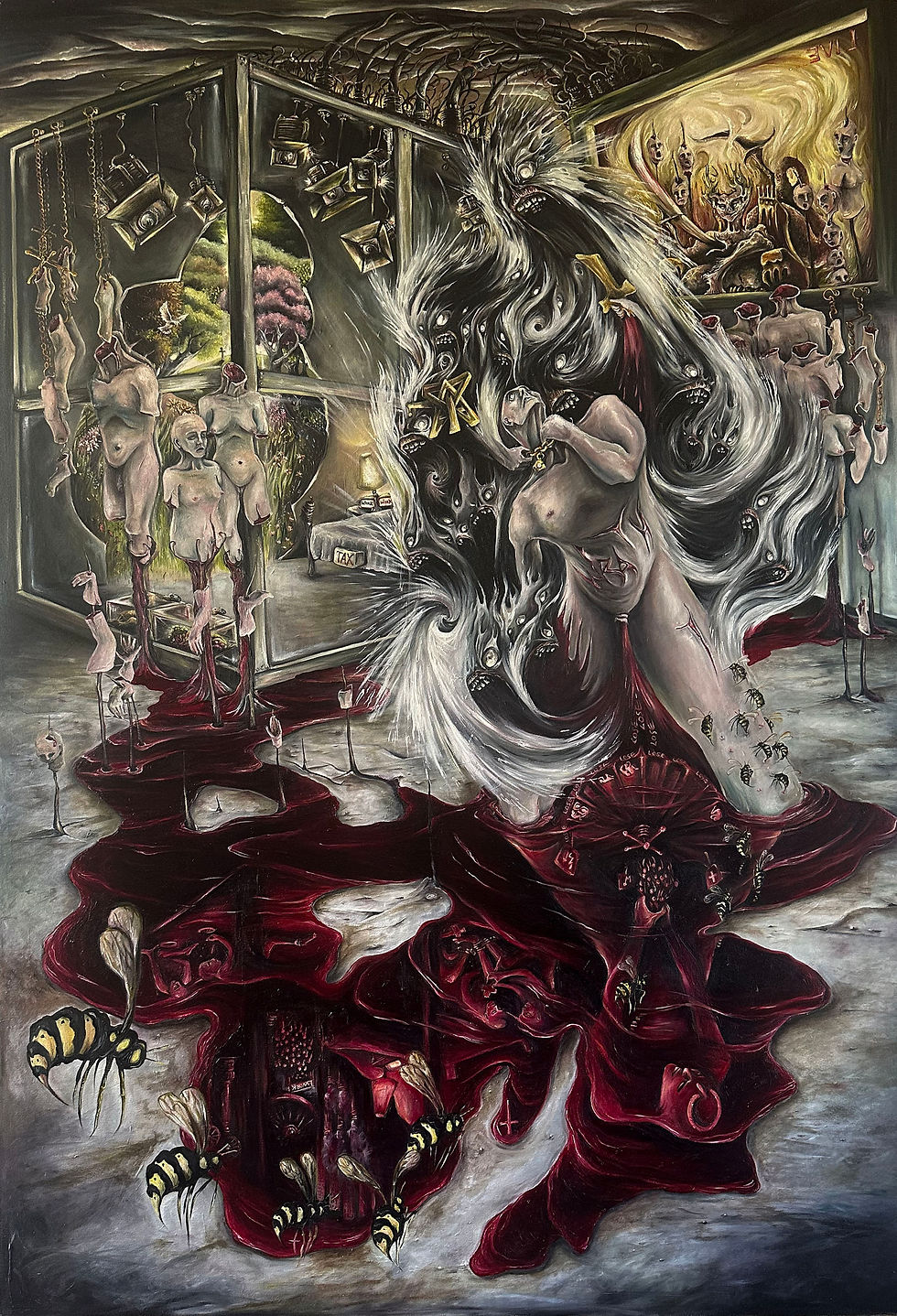
The last of the Seven Deadly Sins.
Where is Wrath born?
Why does it arise?
These are questions I have often asked myself. I have explored my own Wrath and looked deeply into its eyes. It is far more powerful than anger.
Anger is often fleeting.
Wrath lingers.
It waits beneath the surface, patient and watchful. It travels with us throughout our lives, gathering strength from every slight, every insult, every betrayal, every disappointment and every injustice we fail to confront.
Each experience becomes another stone we carry.
On their own they seem insignificant.
Together they become a crushing weight.
Unlike anger, Wrath is a force of nature. It reminds me of the weather. Pressure builds quietly beneath the surface until one day the storm breaks, unleashing devastation upon everything in its path.
When Wrath takes hold, reason disappears.
It is blinded by the intensity of its own emotion.
To me, Wrath is born from wounds left unattended. It grows from pain that has never been acknowledged, grief that has never been expressed, and trauma that has never been allowed to heal.
This is why I believe we should never bury our emotions indefinitely.
Human beings are not designed to be pressure cookers.
Some people have the remarkable ability to let life's difficulties wash over them. Others cannot. They hold on to every hurt until those hurts begin to define them.
Wrath is what happens when emotion remains unchecked for too long.
In many cases, the feeling itself is understandable. The hurt is real. The anger is justified.
But when Wrath finally erupts, its response is rarely proportionate.
It destroys far more than the thing that first created it.
Wrath is war.
Wrath is the desperate need to release years of accumulated pain without caring where that pain lands.
Today I see Wrath everywhere.
I hear it in the way people speak to one another.
I read it in the comments that flood our timelines, where strangers feel entirely justified in attacking people they have never met.
Wrath rarely stands alone.
It calls for company.
Across the internet it spreads like wildfire, feeding on outrage, fear and division. Every angry voice encourages another until the fire becomes almost impossible to extinguish.
Wrath feeds upon our insecurities.
It preys upon our sadness.
It exploits our deepest wounds.
And for many, the rush of righteous anger becomes addictive.
That, perhaps, is its greatest deception.
Wrath is highly contagious.
But imagine if love were just as contagious.
Imagine if kindness spread as quickly as outrage.
Imagine if laughter travelled as fast as hate.
I have always been struck by how easily people are drawn towards darkness. Misery often seeks company, while joy seems to require conscious effort.
Perhaps that is why kindness is such an act of courage.
I believe we should strive to become people whose glasses overflow—not with anger, but with compassion.
We should laugh more.
Love more.
Forgive more.
Respect one another more.
Because if the Seven Deadly Sins have taught me anything over the past twenty years, it is this:
Every one of them lives within us.
Every day we choose which one we feed.
And every day we also have the opportunity to choose something better.
Final Thoughts
As I come to the end of The Seven Deadly Sins collection, I find myself reflecting on what I have achieved over the past three years. My aim has been to weave my own understanding of each sin into these paintings, creating visual narratives that invite the viewer to look beyond the obvious. I hope that by reading these essays alongside the artwork, you can begin to see the ideas, questions and observations that inspired them.
I hope you have enjoyed my interpretation of the Seven Deadly Sins. This collection has been as much a journey of self-discovery as it has been an artistic one. Throughout its creation, I found myself examining not only the world around me but also the darker corners of my own character.
Every one of us carries these sins to some degree.
The challenge is not to pretend they do not exist, but to recognise them, understand them, and perhaps become a little better because of that understanding.
Within each painting, I have included each counterpart to each sin The Seven Heavenly Virtues—but with a twist. Rather than portraying virtue as purely good, I explore the ways in which even virtue can be manipulated. There are times when kindness is performative, humility becomes self-promotion, generosity seeks applause, or compassion is used as a mask to disguise selfish intentions. Virtue without sincerity becomes little more than another performance, another way to feed the ego while appearing morally superior.
For those interested in discovering the symbolism and stories behind each painting, I have written individual blogs exploring the imagery in greater depth.
I am not here to judge anyone.
These are simply my observations as someone fascinated by human nature.
I am a sinner too.
Every day I try to become a slightly better version of myself. Sometimes the progress is significant; more often it is very small. But I believe that small improvements, repeated over a lifetime, shape the person we become.
I cannot change how others choose to live, nor would I want to. What I can do is share my perspective and invite conversation. These paintings are a window into my psyche and the way I interpret the world. Someone from a different background may see something entirely different—and that, to me, is one of the greatest joys of art.
Art creates conversations.
It encourages us to question.
It asks us to look a little deeper.
Whether you agree with my interpretations or challenge them completely, I hope these paintings have made you stop and think for a moment.
After all...
We are all sinners.
And finally, if you share my slightly mischievous sense of humour, why not embrace it? Pop over to the shop, pick up one of my Own Your Sin T-shirts, and wear your favourite deadly sin with pride... perhaps not too much pride.


Comments