
Wrath: Symbolism, Human Nature and the Seven Deadly Sins in Contemporary Oil Painting

Updated: Sep 1
Wrath Painting by Julia O'Sullivan
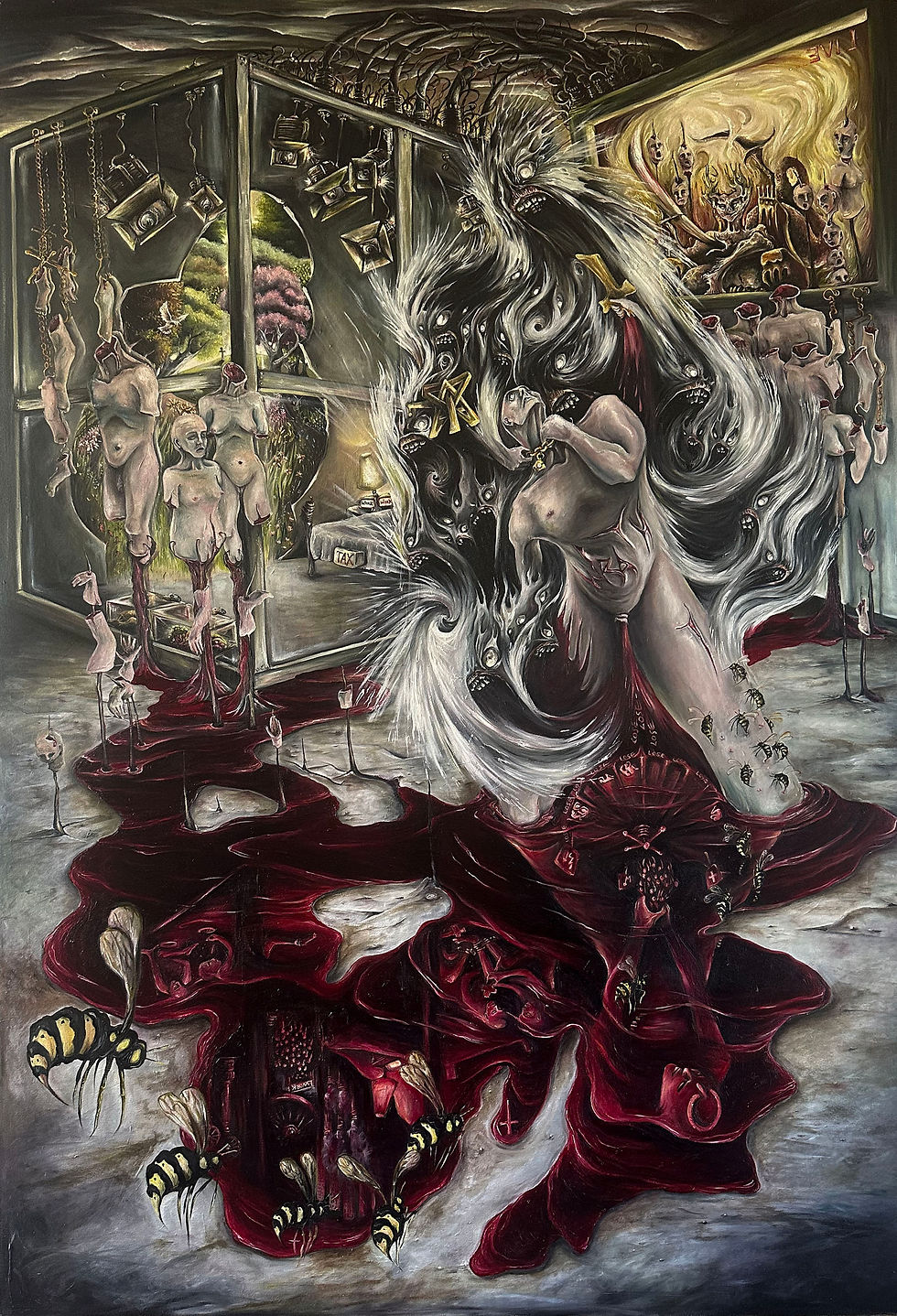
What Does Wrath Mean to Me?
When I began Wrath, I wanted to search the furthest corners of my own mind.
I wasn't interested only in what Wrath looked like. I wanted to know where it came from.
More importantly, I wanted to know:
Where was it born inside me?
Wrath's opposing virtue is Patience, and I realised that somewhere between those two subjects lay the story I wanted to paint.
For me, anger had grown from years of torturing myself over things beyond my control. I would carry them, question them, replay them and allow them to occupy places in my mind long after I could do anything to change them.
And beside that anger sat Patience.
Its cold ally.
Patience held its hand while something darker grew.
That interested me enormously because we are taught to think of Patience as good and Wrath as bad. But inside my own mind, the relationship was not nearly that simple. Patience could contain anger, but containment did not necessarily make the anger disappear.
Sometimes it simply gave it somewhere to grow.
So I wanted to paint the darkest side of both.
I wanted to understand how far someone could be pushed before everything they had contained finally broke free.
My Patience therefore sits caged within my mind, quietly creating a shiv to use against the monster that has been growing there.
And when that anger is finally released, it does not emerge calmly.
It comes in full fury.
Destructive. Chaotic. Blinded by everything swirling around it.
There is no measured response left. No carefully considered justice. It is vengeance without remorse.
That is my Wrath.
It is the deepest, darkest passenger I have carried within me.
I think, in part, carrying it has rotted a small part of my soul. But painting it has allowed me to do something with it. Instead of keeping it imprisoned inside me, I can release it onto the canvas.
Perhaps that is why creating these paintings has brought me an unexpected sense of calm.
Throughout this collection I have forced myself to ask questions I might otherwise have avoided. Some have been uncomfortable. Some have been incredibly dark. But rather than allowing the answers to remain inside my head, I have woven them into the paintings.
Wrath became one of those releases.
But once I had confronted my own Wrath, another question appeared.
What about everybody else's?
What creates so much anger in the world?
What happens when ordinary people are subjected to relentless pressure, rules, taxation, financial insecurity and systems over which they feel they have increasingly little control?
How long can good people continue to endure before something begins to crack?
That question allowed the painting to move beyond my own mind.
The cage became larger.
It became society.
I began using the pressures of the economy, work and political power to explore how anger can be given life. People work, pay, obey and continue. They are offered promises by those with power and choices that may not always feel like choices at all.
And still they are told to be patient.
But people have limits.
I have often wondered what would happen if the people upon whom the entire economic structure depends simply stopped.
What if, collectively, they said:
Not today.
The consequences would be extraordinary.
Because perhaps we sometimes forget where the real power lies. Individually we can feel insignificant within enormous systems, but collectively we are the system that allows them to function.
Push people far enough and eventually cracks appear.
Patience breaks.
Pandora's box opens.
And Wrath escapes.
All of this exists within the painting, but it is buried beneath layers of symbolism. Eden sits almost within reach while humanity continues to inhabit the structures it has created for itself.
That may be the saddest thought within Wrath.
We live on Eden's doorstep, yet repeatedly choose man's creation instead.
This journal is my attempt to take you inside that painting.
Not simply to show you where the symbols are, but to explain why they exist.
Some belong to society.
Some belong to humanity.
And some belong to the darkest corners of me.
Chapter One – What is Wrath?
Wrath is perhaps the most misunderstood of the Seven Deadly Sins.
We often use the words anger and wrath as though they mean the same thing, but I don't believe they do. Anger is one of the most natural emotions we possess. It tells us when something is wrong. It can compel us to protect ourselves and those we love, challenge injustice and refuse to accept what should never have been acceptable in the first place.
Anger can have a purpose.
Wrath begins when that purpose changes.
It is the point at which anger stops asking for something to be put right and begins wanting something—or someone—to be punished. Hurt becomes resentment. Resentment becomes hatred. The desire for justice slowly gives way to the desire for retribution.
That distinction became fundamental to this painting.
What has always interested me about Wrath is that it does not necessarily begin with something evil. It can begin with genuine hurt. A person may have been betrayed, humiliated, controlled, ignored or treated unjustly. Their anger may be entirely understandable.
And perhaps that is what makes Wrath so dangerous.
Because when we believe our anger is justified, it becomes remarkably easy to believe that everything we do because of that anger must also be justified.
But it isn't.
There is a point at which the person who has been wronged can begin inflicting wrongs of their own. The victim can become the aggressor. Justice can become vengeance, while still being called justice by the person carrying it out.
For me, that transformation is Wrath.
Violence is only its most visible expression. The real transformation has happened much earlier, quietly and internally, as hurt has been allowed to accumulate and revenge has gradually become more desirable than resolution.
This is why I don't see Wrath simply as uncontrolled rage. I see it as a process.
And that process is what I have painted.
I am not asking the viewer to condemn anger. Nor am I suggesting that people should quietly endure injustice in the name of virtue. In fact, as this painting unfolds, I question that idea just as strongly.
Instead, Wrath asks where the boundary lies.
At what point does justified anger stop seeking justice and begin creating a new injustice of its own?
Chapter Two – The Birth of Wrath
Every painting within my Seven Deadly Sins collection tells a story, and Wrath is no different.
At first glance, the eye is drawn towards the violence.
Wrath is already loose.
Around the attacking figure are blurred, almost human faces, their features obscured and their pupils stark white. I painted them this way to represent blind rage: the moment when anger has overwhelmed reason and people cease to truly see what is in front of them.
Individuality begins to disappear.
They become part of the frenzy.
But anger itself is also present in the painting, and I chose to represent it as a wasp.
The wasp is important because anger and Wrath are not the same thing.
A wasp stings.
Its response can be immediate, sharp and defensive, particularly when it feels threatened or disturbed. That is how I see anger. Something hurts us, frightens us, humiliates us or crosses a boundary, and anger reacts.
It is a warning.
Wrath is what happens when that sting becomes something more.
At the centre of the violence stands the man.
He is being attacked, and if we looked only at this part of the painting it would be easy to see an aggressor and a victim and decide immediately who was right and who was wrong.
But Wrath is not that simple.
To understand what is happening, we have to look backwards.
The blood beneath the violence becomes a reflection of what came before.
Within it, the same man occupies a very different position.
Here, he possesses the power.
He casts people onto a great roulette wheel, reducing their lives and futures to chance. He determines what happens to others while remaining removed from the consequences of those decisions.
The balance of power has completely reversed.
The man who appears to be the victim outside the reflection was once the figure in control within it.
That reversal was essential to the painting because I wanted to explore something that has always troubled me about Wrath:
What happens when those who have repeatedly been powerless eventually gain the power to retaliate?
The wasp helps mark the beginning of that transformation.
First comes the sting.
Then another.
And another.
Every humiliation, injustice and act of control adds something more. Anger that initially demanded change begins to carry memory with it. When nothing changes, resentment takes its place.
Eventually, the desire to be heard can become the desire to hurt.
That is where anger becomes dangerous.
And that is where Wrath begins.
Outside the reflection, the consequences have arrived.
The man is no longer controlling the fate of others. He is confronted by something his own actions helped to create, and Wrath has no interest in negotiation, understanding or resolution.
It wants retribution.
I deliberately painted Wrath as a separate entity rather than simply transforming one of the figures into Wrath.
That distinction matters.
Wrath is the monster born between them.
It is created in the space between the person who inflicts suffering and the person forced to endure it. By the time it emerges, it belongs completely to neither. It has developed its own momentum.
And once released, it does not simply correct the original injustice.
It creates another.
The oppressor becomes the victim.
The victim becomes the aggressor.
The cycle turns.
The wasp's sting has become something far more destructive than the anger with which it began.
Anger can sting. Wrath wants to destroy.
But if we want to understand how that transformation was allowed to happen, we have to look at what was containing all that anger before it finally escaped.
We have to look at Patience.
Chapter Three – The Prison of Patience
If Wrath is the monster created by everything that came before, then Patience is where its story truly begins.
At the heart of the painting sits Patience, chained inside a cage.
Those chains are important.
There is a profound difference between choosing to be patient and being forced to endure. Here, Patience has no choice. She waits because she is trapped. What should be a virtue has gradually been transformed into submission.
The cage itself represents far more than physical imprisonment. It is built from the structures of everyday existence: responsibility, obligation, work, money, authority and all the demands placed upon us simply to participate in society.
Even the means of unlocking it has been corrupted.
The cage is locked with a key whose extension carries one word:
TAX.
The very object that should offer freedom has become part of the mechanism keeping Patience imprisoned. We work to survive, we earn, we pay, and then we pay again. Gradually, these demands become so familiar that we cease to question the structure surrounding us.
Inside the cage, ordinary life continues.
There is a bed, offering somewhere to sleep before beginning again. Across the floor sit small glass boxes, each demanding payment before it can be used. Even within confinement, the necessities of existence have a price.
Nothing is free.
Not even time.
Beside the bed is a digital clock displaying two faces, one red and one blue.
These colours run throughout my Seven Deadly Sins collection and carry a deliberate political meaning. They represent the two major political houses: apparently opposing sides offering us the freedom to choose between them.
But I use red and blue to question how much choice we really have.
You have a choice, but no choice.
In Wrath, whichever colour you choose, the message on the clock remains exactly the same:
WORK.
Red or blue.
WORK.
The colour changes. The demand does not.
The clock therefore measures more than time. It represents a system in which we are repeatedly presented with choices while the fundamental expectations placed upon us remain unchanged.
Work. Earn. Pay. Sleep.
Then begin again.
I wanted this prison to feel uncomfortable because so much of it is recognisable. Its bars are not merely made from metal. They are formed from ordinary things we accept as part of life, until we perhaps stop noticing that they have become bars at all.
And Patience is being watched.
Eyes peer into the cage, observing everything happening within it. They represent the dominance of man, authority and surveillance: the uncomfortable feeling that our behaviour is continually watched, judged, measured and controlled.
Patience has somewhere to sleep.
She has somewhere to work.
She has things she can use, provided she pays for them.
She is even allowed to choose between red and blue.
But is she free?
Beyond the cage, it appears that she might be.
Part of the wall has been broken away, and through that opening another world can be seen. Eden appears within reach. A dove represents freedom, while upon the hillside stands the upright cross.
The orientation of the cross is another visual language that runs throughout my Seven Deadly Sins collection. Wherever sin dominates, the cross is inverted. With virtue, it stands the right way up.
Here it offers the possibility of something beyond the cage.
Patience can see freedom.
She can almost reach it.
And perhaps that makes her imprisonment crueller.
Because how long can we ask someone to remain patient when they can see another existence just beyond the wall?
We are taught that Patience is a virtue.
Wait.
Endure.
Don't react.
Don't cause trouble.
Be patient a little longer.
But there must surely come a point when patience stops being virtuous.
When people are continually asked to endure injustice rather than challenge it, Patience can become the very thing that keeps them imprisoned.
And eventually, even Patience reaches her limit.
But there is something she cannot yet see.
The freedom beyond the broken wall is not quite the same when we look at it through the blood.
Wrath.
Chapter Four – The Reflection of Patience
Throughout my Seven Deadly Sins collection, the opposing virtues appear only as reflections.
This was never simply an artistic device.
A reflection forces us to look back at ourselves.
It is where we examine who we are against who we believe ourselves to be. We may tell ourselves that we are patient, kind, charitable, humble or virtuous, but the reflection asks a more uncomfortable question:
Are we really?
In Wrath, Patience is reflected within blood.
I chose blood deliberately.
Blood carries the evidence of injury. It represents wounds, sacrifice and suffering, but here it also becomes a record of everything that has been endured. Patience has absorbed every injustice without retaliation, and the blood beneath the painting holds the consequences.
But the reflection does something else.
It reveals what the world outside it conceals.
Outside the blood, the broken wall of Patience's cage appears to lead towards freedom. Beyond it are Eden, the dove and the upright cross. There seems to be another life waiting if only Patience can reach it.
Look into the blood and that promise changes.
The opening is still there.
But Eden is gone.
Instead, the escape leads directly towards a workhouse.
And that workhouse powers the city of the rich.
This was important to me because I wanted to question what we sometimes call freedom.
Patience escapes one cage only to discover another waiting beyond it.
She can leave the visible prison, but only by entering a system in which her labour feeds the prosperity of those above her. The walls may have changed, but the relationship between power and powerlessness remains.
Freedom has been offered without freedom ever truly being given.
It echoes the red and blue choice elsewhere in the painting.
Different doors.
Different promises.
The same destination.
You have a choice, but no choice.
And Patience remains chained.
That is perhaps the cruellest part of the reflection.
She has done everything that virtue asks of her. She has waited. She has endured. She has restrained herself. She has accepted what has been placed upon her and continued to hope that eventually there will be something better.
Yet the reward for her patience is simply another form of servitude.
This is where I begin to question the virtue itself.
Patience is admirable when it prevents us from acting impulsively, allows us to understand others and gives difficult situations time to change.
But what happens when nothing changes?
At what point does telling someone to be patient become another way of telling them to accept their own suffering?
There must be a boundary between patience and submission.
If a person is continually exploited, controlled or denied freedom, asking them to remain patient indefinitely does not necessarily make them virtuous. It may simply make the system exploiting them easier to maintain.
Perhaps this is why Patience stands at the centre of Wrath.
She is not Wrath's simple opposite.
She is part of its creation.
Every injustice she tolerates remains inside her.
Every time she waits rather than reacts, the pressure grows.
Every promise of freedom that leads to another cage adds something more.
Until eventually Patience is no longer capable of containing what has been placed inside her.
The reflection therefore does not show us Wrath.
It shows us why Wrath becomes possible.
And somewhere beyond Patience's suffering, someone is watching all of this unfold.
Chapter Five – The Pride Devil
Throughout my Seven Deadly Sins collection, the Devil does not represent the sin named in the painting.
Each Devil carries another of the Seven Deadly Sins.
I did this deliberately because I don't believe the sins exist neatly in isolation. One feeds another. Pride can provoke Wrath. Envy can encourage Greed. Lust can be driven by Pride. They overlap, collide and create the conditions in which another sin can flourish.
In Wrath, the Devil represents Pride.
And Pride is here for a reason.
The Pride I am exploring is not healthy pride in something we have achieved. It is the arrogance that convinces a person that their position places them above everyone else.
It says:
I know better than you.
I am more important than you.
I have the right to decide what happens to you.
That is the Pride I see within the man.
He casts people onto the roulette wheel because he believes he has the authority to determine their fate. Their suffering is distant from him. He does not have to experience the consequences of his decisions, so he can continue making them.
Pride allows power to exist without empathy.
And perhaps even more dangerously, it allows those who possess that power to believe they deserve it.
This is why I chose Pride to stand beside Wrath.
Pride does not need to throw the first punch.
It creates the conditions in which the punch will eventually be thrown.
The Devil himself remains strangely calm amongst the chaos.
While everyone else is consumed by what is happening, he watches.
He has been watching for some time.
A live feed from Patience's cage allows him to observe everything unfolding within it. He sees the confinement, the surveillance, the endurance and the pressure building.
And he smiles.
Not because he built the cage.
Humanity did that perfectly well without him.
He smiles because he understands what those inside it have failed to understand.
This cannot continue forever.
The Devil does not need to whisper temptation into anyone's ear. He does not need to manufacture hatred or persuade someone to become violent. The choices have already been made and their consequences are already unfolding.
All he has to do is wait.
Pride believes itself untouchable.
That is its weakness.
It assumes that those beneath it will continue to obey, continue to endure and continue to accept their position. It mistakes Patience for weakness and silence for consent.
Until Patience is no longer patient.
Then something extraordinary happens.
Pride helps create Wrath, and Wrath turns upon the very power that created it.
But there is no victory in that reversal.
Because once Wrath abandons justice for vengeance, another sin has been born from the first.
That is why my Devil smiles.
He hasn't had to do anything.
Pride created the injustice.
Injustice created the conditions for Wrath.
Wrath crossed the line into vengeance.
The Devil has simply watched humanity do the work for him.
He has come only to collect.
Chapter Six – The Punishment of Wrath
Throughout my Seven Deadly Sins collection, I have incorporated the traditional punishment associated with each sin into the paintings themselves.
For Wrath, that punishment is dismemberment.
It is perhaps one of the most brutal punishments associated with the Seven Deadly Sins, and I wanted that brutality to be unmistakable.
Throughout the painting, bodies are broken apart.
Severed limbs and fragmented human forms surround the violence, creating a scene in which the human body itself has been torn into pieces.
But for me, dismemberment means more than physical destruction.
Wrath fragments everything it touches.
It separates reason from emotion.
Justice from vengeance.
Compassion from judgement.
And eventually, one human being from another.
The blurred faces with their white pupils reinforce this loss of reason. Individual identities begin to disappear into the frenzy. They no longer truly see. They have become consumed by blind rage, caught within something larger than the original grievance that created it.
This is why dismemberment felt such an appropriate punishment for Wrath.
Wrath does not repair what has been broken.
It breaks something else.
One of the most important symbols within this destruction is also one of the smallest.
The weapon being used against the man was once a cross.
It belonged to Patience.
Earlier in the painting, the cross represented hope, virtue and the possibility of something beyond the cage. But by the time Wrath takes control, that same cross has been sharpened and transformed into a crude shiv.
I wanted that transformation to be deeply uncomfortable.
The symbol of Patience has become the weapon of Wrath.
Something that once represented endurance and hope is now being used to inflict suffering.
The cross has not simply been discarded.
It has been corrupted.
That distinction matters because Wrath does not erase what came before it. It takes the hurt, the beliefs and even the virtues that existed before and twists them into something capable of causing harm.
The weapon therefore carries the history of the painting within it.
Patience endured.
Patience reached her limit.
And what once represented her virtue has become part of the violence that follows.
The Pride Devil also carries a machete.
But he is not the one creating the destruction.
He does not need to.
The punishment is already happening around him.
Dismemberment is not waiting somewhere in Hell as a consequence yet to come. I have brought it into the painting because the punishment of Wrath begins the moment Wrath takes control.
Everyone becomes damaged by it.
The person against whom the anger is directed.
Those caught within its path.
And ultimately, the person consumed by it.
That is the real horror of Wrath.
It may begin with a legitimate wound.
It may even begin with a demand for justice.
But once it becomes vengeance, it cannot restore what was taken.
It can only create more pieces.
By the time the body is dismembered, something within the human spirit has already been torn apart.
Chapter Seven – Living with Wrath: Why We Collect Symbolic Art
Why would anyone want to live with a painting about Wrath?
It is a fair question.
Art does not always have to be beautiful in the conventional sense. It does not always have to calm us, match our furnishings or provide an escape from the world.
Sometimes its purpose is to make us think.
That is the kind of art I create.
I have never wanted Wrath to be something that can be understood in a single glance. From a distance, you see the whole. Move closer and individual stories begin to emerge. Look again and something previously unnoticed may suddenly change the way you understand what you have already seen.
For me, that is the difference between simply looking at a painting and living with one.
Symbolic art continues to reveal itself.
The meaning may also change with the person standing in front of it.
One viewer may recognise the danger of allowing anger to become vengeance. Another may identify with Patience and question how much they themselves have tolerated. Someone else may be drawn to the political commentary, the structures of power or the illusion of choice.
Another may simply see humanity repeating the same patterns it has repeated for centuries.
None of those responses has to be the same as mine.
I can tell you why I painted every symbol and what each of them means to me, but once the painting leaves my hands, I cannot dictate the conversation someone else has with it.
Nor would I want to.
That is one of the reasons I am drawn to narrative art.
A painting can hold a story without providing a simple answer.
Wrath certainly does not provide one.
There is wrongdoing on both sides of its story. There is suffering, responsibility, consequence and retaliation. There are moments when sympathy becomes uncomfortable because understanding why something happened does not necessarily mean approving of what happened next.
That ambiguity gives the painting somewhere to go beyond the wall on which it hangs.
It can provoke conversation.
Two people can stand before the same image and disagree completely about what they see. One may defend the anger while another condemns the violence. One may see Patience as virtuous; another may see her endurance as part of the problem.
And perhaps, sometime later, they may look again and change their minds.
That matters to me.
I don't create art to tell people what they should think.
I create it because I want them to think.
To question.
To look again.
To notice the detail they missed the first time and wonder why I placed it there.
Living with symbolic art means living with those questions.
The painting remains physically unchanged, but we don't. Our experiences alter us. Our opinions shift. Things that once seemed obvious become complicated, while details we once overlooked suddenly acquire meaning.
The artwork waits for us to catch up.
Perhaps that is why people choose to collect work that challenges them.
Not because they necessarily want an answer hanging on their wall.
But because they have found a question worth living with.
And Wrath leaves us with one final question.
Epilogue – The Question I Leave with You
When I began painting Wrath, I was not interested in simply painting anger.
I wanted to understand what happens before it.
What makes a person who has endured finally turn?
And when they do, who carries the responsibility for what follows?
Throughout this painting there are people making choices, people denied choices and others who believe they are offering choices when, in reality, the outcome has already been decided.
There is power.
There is endurance.
There is injustice.
And eventually there is retaliation.
It would be easy to look at the final violence and condemn Wrath.
Perhaps we should.
But I think we should also be willing to look backwards and ask what created it.
Understanding the origin of Wrath does not excuse what Wrath becomes. A person can have every reason in the world to be angry and still become responsible for the suffering they inflict upon someone else.
That is the uncomfortable space in which this painting exists.
I don't believe there is a neat answer.
I am a sinner too. I live every day trying to understand myself, my reactions and the world around me a little better. I am not standing outside this painting passing judgement on everyone within it.
I am observing.
Questioning.
And perhaps recognising that the distance between virtue and sin is sometimes much smaller than we would like to believe.
Patience can endure too much.
Power can become Pride.
Anger can become Wrath.
And justice can become vengeance while the person seeking it remains completely convinced that they are right.
So I leave you with the question that sits at the heart of Wrath:
If your anger began with a genuine injustice, how far could you go before you became responsible for an injustice of your own?
And would you recognise the moment you crossed that line?
Wrath — The Final Layer
Wrath did not begin with the anger you see in the finished painting.
It began much earlier, with the questions that drove me back to the Seven Deadly Sins and eventually into a three-year journey examining sin, virtue and the uncomfortable space between the two.
The Seven Deadly Sins Collection is where that journey begins. It asks the questions that made me want to pull these ancient ideas apart and examine what they might mean within our lives and society today.
The Wrath Creation Gallery takes you into the making of this particular painting. There, you can follow Wrath from its first sketch through the early colour and changing composition as layer after layer accumulated over the three years.
Wrath may explode in an instant.
This painting didn't.
It grew slowly, patiently and deliberately until the smallest details finally completed the world I had been building.
And here, in this Artist Journal, you have reached the final layer.
This is where I reveal what all of that imagery means—the experiences, observations, symbolism and questions that ultimately turned those layers of paint into Wrath.
The Collection asks why I began.
The Creation Gallery reveals how Wrath grew.
The Artist Journal tells you what lies behind the finished painting.
Three different ways of entering the same work.
And perhaps, after travelling through all three, Wrath no longer looks quite like the painting you first encountered.
Continue Exploring The Seven Deadly Sins
Explore the Other Artist Journals
Every Sin has its own story. Enter the other paintings and discover the symbolism, personal thoughts and questions hidden within
Seven paintings. Seven virtues. Seven very different ways of looking at what makes us human.


Comments